
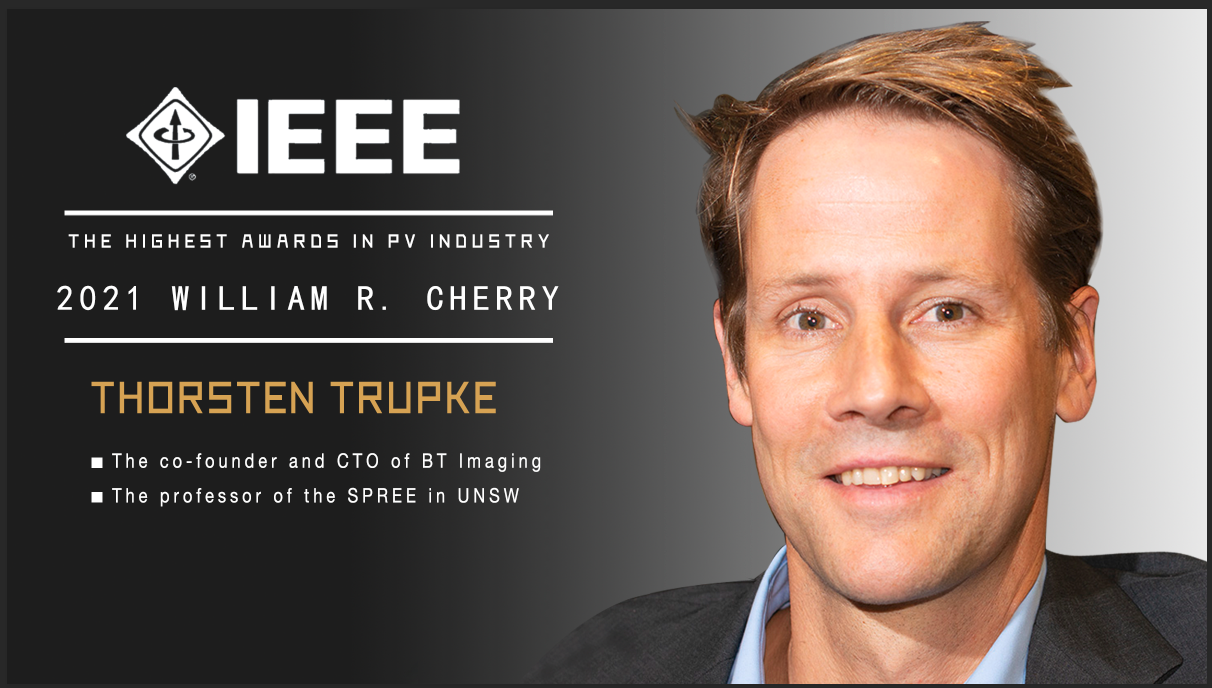
2021 IEEE William Cherry Award to be presented at the 48th IEEE PVSC to Professor Thorsten Trupke
Thorsten Trupke is a Professor at the School for Photovoltaic and Renewable Energy Engineering at the University of New South Wales where he leads a team of approximately 15 PhD students, Postdoctoral Fellows and staff. He is also Chief Technology Officer and co-founder of Sydney based company BT imaging and a Fellow of the Australian Academy of Technology and Engineering.
Thorsten holds a PhD in Physics from the University of Karlsruhe, Germany, which he completed under the supervision and guidance of Professor Peter Würfel. In 2001 he moved with his family (Thorsten is married with four children) from Germany to Australia, to join Prof Martin Green’s new Centre for Third Generation Photovoltaics at UNSW, supported by a Feodor Lynen Fellowship provided by the Alexander von Humboldt Foundation. He proposed the concepts of combining conventional solar cells with up and/or down-conversion including limiting efficiency calculations and experimental proof of concept studies. In 2004 Thorsten joined forces with Dr Robert Bardos to develop novel luminescence-based characterisation methods and systems, including QSS-Photoluminescence lifetime measurements and Suns-Photoluminescence. His most impactful contribution to date has arguably been the development of photoluminescence imaging for silicon wafers and solar cells, first demonstrated by Thorsten and Robert at UNSW in 2005. This measurement principle, and a large number of associated analysis methods, have since then become standard tools used by researchers and in PV production on a daily basis. The ability to detect a wide range of device and material defects accurately and quickly from PL images has contributed substantially to the rapid improvement and cost reduction of silicon solar cell technology over the last ten years. His team at UNSW continues to drive this technology and the associated fundamental device physics forward, recently with emphasis on downstream applications for outdoor module testing.
Thorsten co-founded BT imaging in 2008, the company provides PL imaging systems to the R&D community and to wafer and solar cell manufacturers. PL tools by BT imaging are found in most R&D labs and in high volume manufacturing worldwide. He enjoys his dual roles in academia and in the industry and the resulting opportunities to work with optimistic colleagues and friends to turn fundamental and innovative research into real world applications and products.
In his private life Thorsten’s favourite pastime is ocean swimming, he spends considerable time in the waters surrounding the beautiful coastline around Sydney.
About the Award
This award is named in honor of William R. Cherry, a founder of the photovoltaic community. In the 1950’s, he was instrumental in establishing solar cells as the ideal power source for space satellites and for recognizing, advocating, and nurturing the use of photovoltaic systems for terrestrial applications. The William R. Cherry award was instituted in 1980, shortly after his death. The purpose of the award is to recognize an individual engineer or scientist who devoted a part of their professional life to the advancement of the science and technology of photovoltaic energy conversion. The nominee must have made significant contributions to the science and/or technology of PV energy conversion, with dissemination by substantial publications and presentations. Professional society activities, promotional and/or organizational efforts and achievements are not considerations in the election for the award.
Award Package
The award consists of a plaque, monetary award, recognition at the IEEE PVSC Opening Ceremony and a dedicated Cherry Award Talk during the Opening Ceremony.